
Case Studies, How-To Guides, or Listicles: What blog format gets the most clicks?
Content is all over the place, but not every blog format gets the most clicks over others.
It’s important to choose the right format for the right goals. What are your goals? More clicks? Growth? Monetization?
I’ll be comparing three types of blog formats that typically get the most attention on search engines, social media, and online communities. You’ll be able to compare these types of blog posts to determine which blog format gets the most clicks based on your goals.
It all depends on the intent of your content, but there is one type of blog format that consistently wins for most niches.
What Makes a Blog Format Click-Worthy?
It all has to do with psychology.
A blog format that has a high number of readers is one that taps into a person’s curiosity, skimmability, promise of value, and relevance to a pressing need or pain point.
It really matters what the reader’s intent is. This is like search intent. It’s what the reader is intending to get out of reading your content. You’ll drive their intent by how you word the title of your post and the hook you implement into it.
Just make sure you’re delivering the promised intent; otherwise, you’ll become known for giving out bad information, and that will kill your chance of being an authority in your niche.
Different formats are going to hit different intents. A case study is well-thought-out and typically long to read, but that’s going to help someone who needs science and research behind the intent they’re looking to get from your article.
Case Studies
A case study is a type of blog format that thoroughly defines an answer to a question, concern, or pain point of the intended topic.
The typical structure of a case study is the problem, process, and results. It’s as close to a scientific study as blogging can be, and sometimes it is the results of a scientific study. A case study is likely to become a backlink or even be mentioned in educational papers.
A case study demonstrates real-world proof about a conclusion that has been researched, processed, and resulted in some kind of aftermath.
When you write case studies on your blog, you’re giving people facts and unbiased solutions to their pain points. A case study is one of the best ways to build authority and trust within your niche.
Case studies perform really well in B2B and high-ticket audiences because they’re so factual and more professional than the standards of modern blogging.
A case study blog format gets the most clicks for several reasons. When readers want validation or to see behind the scenes, they’ll often look for a case study. You can put a lot of Call-to-Actions in a case study to engage your audience, too.
Case studies are not always the answer, and they can underperform.
If your niche is too niche, you’re probably not in a niche that is in high demand for a case study. If there isn’t a big search volume for such a study, your study will probably get few clicks. Case studies are not friendly to those who skim content or need something that is helpful for beginners.
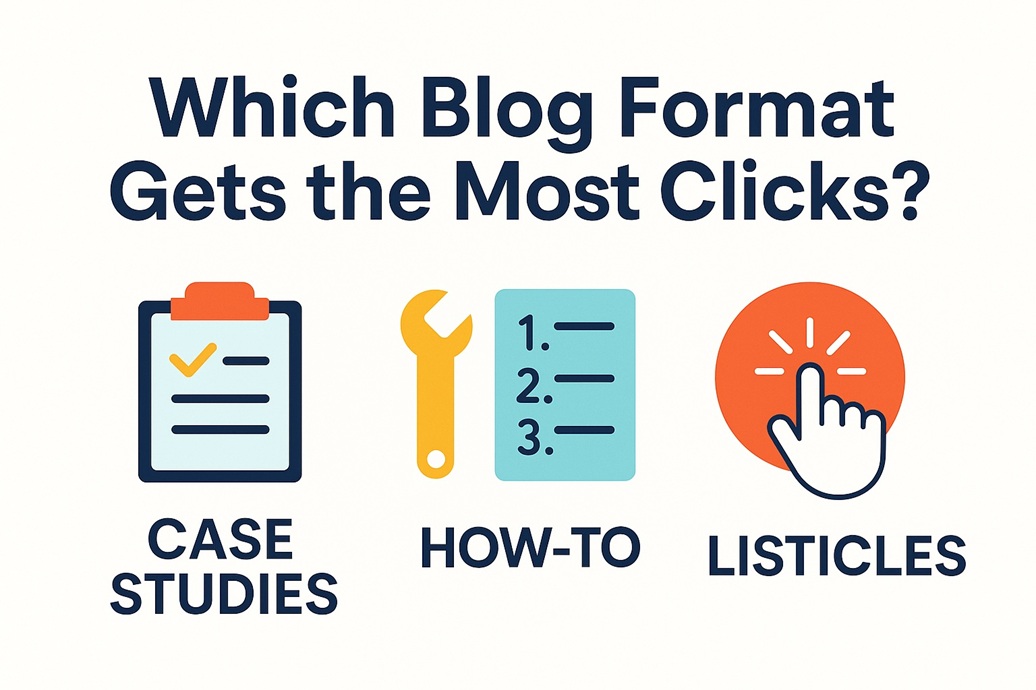
How-To Guides
A how-to guide blog post format gets the most clicks because it shows the reader how to do something that is related to their search intent and pain points.
The typical structure of this format is step-by-step instructions, examples of the steps, and additional tools that will help your audience complete the steps. A how-to doesn’t have to be long or short; it just needs to show people what to do in the easiest way possible.
Your how-to article should solve a problem with clarity in mind.
How-to formats are probably the best type of format to create evergreen content that stays fresh and lasts forever. You also have a big SEO potential with these types of formats, especially as you start sharing them on social media.
How-to blog posts typically get the most clicks when the intent of the reader is to take action to solve their pain points.
You present the problem (pain point) and then provide a solution (how-to article). There are a lot of different platforms where people are searching for this type of format, such as Google, YouTube, Quora, Reddit, and even Pinterest. You can do traditional blogging, video, or a hybrid mixing the two together for better results.
A how-to blog format doesn’t always get the clicks that you think it will get.
The how-to format will likely underperform when the topic is oversaturated because there are so many guides available. If the how-to is too long or too complicated to understand, it’s not going to be the most popular post. You have to choose a topic no one is talking about and make it as easy as you can when providing the solution.
Listicles
A listicle is another type of blog post format that tends to get a lot of clicks because it provides so many different options or results for the topic.
The structure of this format is a listed post. This is usually a numbered list of sections. Each listed item includes quick tips, and the sections are extremely skimmable.
Listicles work because they’re fast to read and they give alternatives to readers who need them as fast as possible.
The clarity and skimmability of a listicle make it very clickable. These work well with feed-based platforms like Facebook, X, and Threads. If your audience doesn’t have the most focused attention, then you should be creating more listicles for them to consume because list posts really appeal to beginners and casual readers.
The listicle blog format gets the most clicks when it delivers exactly what readers want to get out of it.
As a general rule, keep your listicle sections short and easy to read so that the reader can get inspiration faster from them. Keep the topic broad or trending, even if it won’t remain evergreen. Try to make the amount an odd number so that people notice it quicker because we’re too used to seeing even numbers and perfect titles.
A listicle isn’t always the answer to your blog format, though.
If the list feels and seems generic, people are going to pass it up and not read it. If the intent of your reader is to get something really informative, a listicle might be a little too quick for them. Don’t write list posts for advanced and highly technical topics that deserve more research and experimentation than quick list items.
Which Blog Format Gets the Most Clicks?
Taking a look at some of the most popular marketing and search engine optimization channels, we have a nice glimpse into seeing which format ends with better results.
BuzzSumo suggests that listicles and how-to guides are best because they are effective for engagement by readers and they attract link building.
Semrush emphasizes that all three formats are great for SEO, just so long as they’re being used for specific goals in relation to the strategy of the blogger.
Backlinko shares the same opinion as Semrush, stating that all three formats are great for search engine optimization based on the goal of what the article is being created for.
HubSpot views each format as a valuable marketing tool that should be tailored to the different stages of the buying intent and journey.
You can see that the most popular marketing and SEO companies are pretty much in agreement on how each of these formats has a good reason to be used as long as you have a goal for why you’re using them.
The real answer is the intent of the reader and the goal you have created to find that intent.
A listicle is great for a beginner who is looking for something quick. For a solution-seeking reader who has a problem, a how-to guide is going to show them how to solve that problem. But for a professional looking for advanced information, case studies will always win.
The Format With the Highest Click Volume Overall
Each of the formats being discussed in this article will have a high click volume on different platforms for different user intents.
A how-to guide is going to get more clicks in search, as people are searching how to do stuff. A listicle is going to be better on social media because it’s easier to skim through the listed sections and keep swiping after you’re done. A case study needs to be posted on LinkedIn or added to bottom-of-funnel contexts.
Bonus: Why Title Format Matters More Than Format
If you don’t have a strong title on your how-to, listicle, or case study, you’ve basically written something that amounts to trash.
A strong title and most often a hook are required to get clicks on any blog format you decide to use. Think about how your title looks to a reader. Will it match their intent and catch their attention quickly enough to get read?
Let’s take a look at some good examples of titles for each format:
- Case Study: How I grew my Facebook page from 200 to 33,000 followers in 4 Years (Step-by-Step Breakdown.
- How-To: How to EASILY Start a Blog that Will Actually Profit in 2026.
- Listicle: 17 Blogging Mistakes that Will Cause You to Make Less Money.
As you can see, the title matters a lot when creating these articles, no matter what format you choose to go with.
How to Choose the Right Format for Your Next Blog Post
- Step 1: Identify reader intent: What is their pain point? What have they tried so far? What result do they want to get?
- Step 2: Match format to search behavior: Consider if they need something quick – listicle. Do they need all the details – case study? Or do they just want to learn how to do something – how-to.
- Step 3: Consider your goal: Traffic and growth? Sales and funnel? Authority and expertise building?
- Step 4: Look at competition in SERPs: This is the Search Engine Results Pages for the keywords you’re competing for. What are they doing? What format works best for them?
- Step 5: Mix formats strategically: Don’t just stick with one format every time you create a new blog post. Mix them up and watch for the results they provide. Using just one format is boring to your readers and might also burn you out in the process.
My Recommendation
My recommendation of what blog format gets the most clicks is based on my experience blogging for all these years and really understanding who my target audience is.
How-to guides have always brought me consistent traffic to my blog. Listicles are often what become viral on social media and bring me fast traffic, which is great if I have a special or something I need more eyes on. Case studies are meant to gain qualified leads because these are readers who are looking for more information.
I suggest you rotate each format strategically on your blog to get an idea of what each format will do for your blog.
There is no universal winner, really. It all depends on user intent and your goals. Once you gather that intelligence, choosing which format to use will be very simple.
Test multiple formats on your blog and really pay attention to the result.
If you’ve found this article to be helpful for your blogging needs, consider leaving me a small one-time tip to show your appreciation for my dedication to helping you become a better blogger. Your support really motivates me to keep writing more great articles.
If you haven’t already, consider subscribing to my FREE newsletter for more blogging tips, resources, and exclusive content that I do not share anywhere else but the newsletter.

About the Author
Shawn Gossman has created content, blogged, ran online communities, and shared a passion for digital marketing for over twenty years. Shawn believes the best way to help content creators, businesses, brands, and marketers is to give away more than you sell. The same advice is recommended for the readers who follow this blog. Shawn also offers various services for extra help in content creation and blogging.
Grow your online brand with exclusive tips from me sent right to your inbox!